

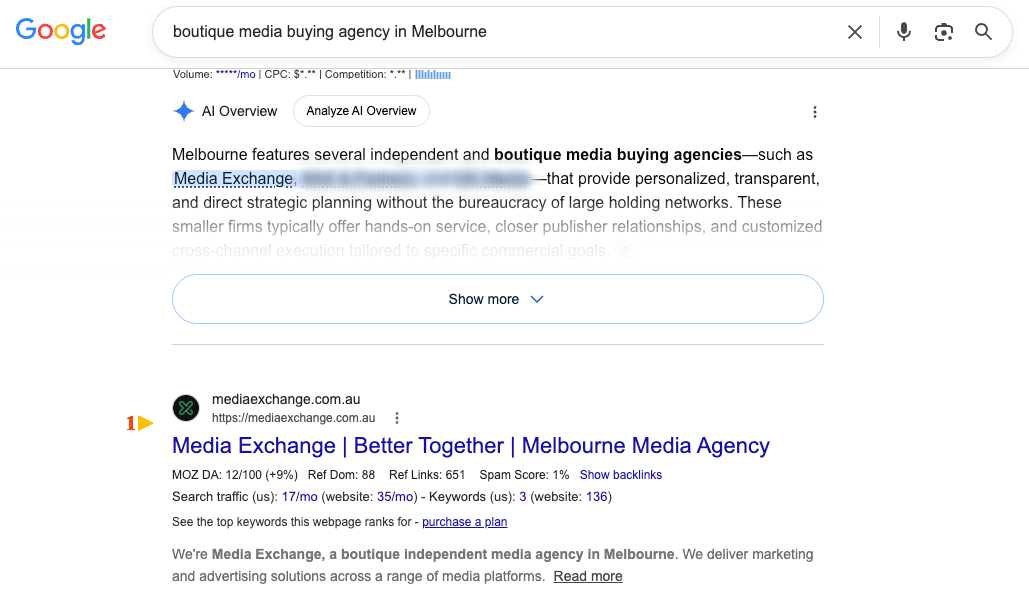
Search your own business now and there’s a good chance the top of the page isn’t a list of blue links anymore. It’s a paragraph, generated by Google, answering the question before anyone has to click through to a website at all, sometimes citing a competitor instead of you.
That’s an AI Overview, and it’s one of the biggest shifts in how Google Search works since results moved to mobile. This guide explains what AI Overviews actually are, why they matter for Melbourne businesses specifically, and what a sensible response to them looks like, alongside what SEO costs to do properly if you’re weighing up next steps.
What is a Google AI Overview?
An AI Overview is an AI-generated summary Google shows at the top of the results page for certain searches, pulling from multiple sources into one answer with links out to where it drew from. Google built the feature as a jumping-off point for exploring a topic further, not a replacement for the results underneath it, using a “query fan-out” approach that runs several related searches behind the scenes and synthesises the results. That’s part of why an Overview often cites a broader, more varied set of pages than a classic top-10 list.
Importantly, Google has been explicit that there’s no special markup, schema, or technical file required to be eligible for AI Overviews. The same SEO fundamentals that support normal rankings — crawlable pages, clear textual content, internal linking, and a solid page experience — are what determine whether a page can be surfaced or cited.
How big is this, actually?
The exact figure depends on which tracking methodology you read, because AI Overview trigger rates vary a great deal by query type and are still moving month to month. But the direction is consistent everywhere.
One tracker put AI Overviews on 48% of all Google queries by March 2026 (Source: The Stacc), up from around 34.5% in December 2025 and 31% in February 2025. Question-style searches, the “who, what, why, how” queries that make up a large share of informational content, trigger an AI Overview far more often than short, one- or two-word searches.
What matters more than the raw percentage is what happens once an Overview shows up. Pew Research tracked real browsing behaviour and found people only clicked through to a website 8% of the time when an AI Overview appeared, versus 15% when it didn’t — roughly half as often. Ahrefs looked at it from a different angle, digging through Search Console data, and landed in the same place: even the #1 organic result loses a big chunk of its clicks once an Overview sits above it. Two different research teams, two different methods, same conclusion.
Ranking #1 doesn’t guarantee you’re in the answer
This is the part that catches even experienced SEOs off guard: ranking at the top of Google no longer means you’ll be the source the AI Overview actually quotes. Seven months ago, about 76% of the pages an AI Overview cited were also sitting in the traditional top 10. Today that’s down to roughly 38%. Google’s pulling its answers from a much wider pool than the old top-10 list.
Being well-optimised for traditional ranking still matters. It’s just not enough on its own anymore to guarantee you show up in the part of the page most people see first.
Why this matters for Melbourne businesses specifically
A lot of local businesses have leaned on “how does this work” style content for years — it’s usually the first thing that brings someone in, before they’re ready to buy. That’s also exactly the kind of search most likely to trigger an AI Overview. So if Google’s now answering that question itself instead of sending someone to your site, a few things follow:
- Your traffic on that early-stage, explainer-type content can quietly drop even while your rankings look fine — which means traffic alone isn’t telling you the whole story anymore.
- Getting cited inside the AI Overview itself is becoming its own goal, separate from just ranking well underneath it. You’ll sometimes see this called GEO (Generative Engine Optimisation) or AEO (Answer Engine Optimisation).
- If your content is more about people ready to buy — get a quote, book now — you’re largely fine. AI Overviews show up far less on searches with that kind of intent.
The sky isn’t falling on every type of content, just the top-of-funnel, explanatory kind, and it’s part of the broader question of whether SEO is worth it in an AI-search world.
What actually improves your chances of being cited
Because there’s no special schema or technical trick that guarantees inclusion, the practical response looks a lot like good SEO always has, just with a sharper focus on a few specific habits.
Answer the Question Directly, Early, and in Plain Language
Google’s systems are drawing together concise, self-contained answers. Content that buries the direct answer under three paragraphs of preamble is harder to extract cleanly than content that states it up front and then explains.
Structure Content So It Can Be Lifted in Pieces
Clear H2/H3 headings, short paragraphs, and genuinely standalone FAQ answers (not “as mentioned above”) all make a page easier for an AI system to parse and cite accurately.
Demonstrate Real E-E-A-T
Google has said explicitly that its systems give more weight to content that shows genuine experience, expertise, authoritativeness and trust, and that trust matters most of all. A named author with real credentials, first-hand examples, and transparent sourcing all support this.
Keep the Fundamentals Solid
Crawlability, clean internal linking, fast and accessible pages, and content that actually matches your structured data all remain part of the baseline, because AI features sit on top of the same index as classic search, not a separate one.
None of this is a new playbook. It’s the existing one, applied with more discipline, because the cost of getting it half-right (silently missing the summary box entirely) is now higher than it used to be.
Frequently Asked Questions
What triggers a Google AI Overview?
Google decides automatically — there’s no setting you can flip. In practice, it comes down to the kind of question being asked. Longer, more conversational searches (“how does X work”, “why is Y happening”) get an Overview far more often than short, two-word searches. Straightforward buying-intent searches trigger them much less.
Do I need special schema markup to appear in an AI Overview?
No — and Google’s been pretty clear about this. There’s no special code or markup that unlocks AI Overviews. What actually gets assessed is the same stuff that’s always mattered: can Google crawl and read your page properly, does your content match what your structured data says, and is the page experience solid.
Will AI Overviews replace my website’s traffic completely?
Not entirely, but they are changing where traffic comes from. Highly informational queries are more affected than commercial, transactional ones, so the practical impact varies significantly depending on what kind of content a page targets.
How is GEO different from traditional SEO?
It’s less a different discipline than an extra layer on top of the one you already know. The foundations — crawlable pages, authority, clear content — are the same. What GEO adds is a sharper focus on making your content easy for an AI to lift cleanly: answering questions directly, structuring things so they can be pulled out in chunks, and backing it up with real expertise.
Can I track whether my content is being cited in AI Overviews?
Sort of. Search Console folds AI Overview appearances into your regular Search data, but it won’t give you a clean, separate report just for AI citations — at least not yet. That gap is exactly why a new wave of AI-visibility tracking tools has popped up recently, built specifically to answer this question.
Should I stop investing in traditional SEO because of AI Overviews?
Not at all. If anything, it’s the opposite! AI Overviews still draw from the same index traditional SEO builds you into, and most of your high-intent, ready-to-buy traffic isn’t affected much anyway. Think of this as a reason to get sharper on fundamentals, not a reason to walk away from them.
Where This Leaves Melbourne Businesses
AI Overviews are a genuine structural change to how Google Search works, not a passing feature. The businesses that adapt well won’t be the ones chasing a technical trick, there isn’t one, but the ones that keep tightening the fundamentals: clear, well-structured, genuinely expert content that answers the question properly the first time.
If you want a clear-eyed look at how your site is showing up (or not) across both traditional rankings and AI-generated answers, talk to our SEO team at Media Exchange for a straightforward audit of where you stand today.